Friday, July 19, 2013

Ramona Falls

 Thirteen hikers gathered early to make the hike to picturesque Ramona Falls, a seven and a half mile in-and-out trek along the Sandy River near Zig Zag. The drive to the trailhead is thirty minutes east of Sandy, Oregon.

The sun-dappled trail curves in and out of a pine, hemlock and Douglas fir forest, following the river of milky water that roars and tumbles from the icy white glaciers of Mt. Hood. The mountain stands like a silent sentinel watching hikers who enter to explore the adventures of the area. As the cool air warms during the morning, it carries the scent of pine.
Sandy River
Mt. Hood


Knickknick, a bushy native ground cover, and mosses carpet the sandy soil of this area. The trail is soft under foot, heavily sandy in spots, reminiscent of a beach, rocky in other areas and always gently climbing to achieve a 1000 foot elevation gain at the falls.

Basalt wall
Half way to our destination a towering basalt wall joins the forest tree trunks, blending visually in the vertical space above our heads. As the sunlight plays on the angular surfaces of the rock, it begins to stand apart from the trees and we see a small water trail trickle down the face of it. An artist in our group stops to snap a few reference shots for a later painting she may do. Others capture shots of the wonderful babbling brook lacing through the tree roots, over rocks and around fallen logs on its way to the big river. The sounds of falling water echo through the trees as we near Ramona Falls.

The visual impact of water splashing stair step fashion down a wall of basalt is a show stopper. Photographers lug tripods and fancy camera equipment to this spot to watch the water play over the rock structure and capture the ever-changing light as the day develops. Full shots, close-ups, angles all provide excellent pictures to share with those who have not yet make the trek to the falls.
Ramona Falls

The cool, swirling mist that forms from the pounding waterfall provides a pleasant atmosphere for a refreshing lunch stop and a chance to rehydrate while resting and taking in the views. Small tufts of grasses and other flora cling tenaciously to spots on the basalt where the water merely sprinkles instead of crashes. There are camping spots above on the  hill and alternate trails leading out of this area. Be sure to have well-marked maps before venturing away from the main trail.

Tenuous grasses cling to the rocks


Our return trip is speedier as the hikers want to beat the heat of rising temps and the afternoon hiking set that is populating the trail.  The views going back down provide a look at the soil layers seen when high winter waters of the Sandy River carve deep into the banks. Boulders, stones and sand mix to create what appears to be an unsteady shoreline. The trail meanders further away from the edge as hikers realize the potential dangers of a crumbling edge.


Gradation of soil along the bank
Giant split rock or dinosaur egg?
Questions are always in mind as we wonder at the volume of water cascading down this part of the mountain; how did the largest of the boulders end up so far from the river; how did this huge boulder crack like an egg? Answers elude us but the marvel of nature remains.


Consider taking this wonderful hike before the snow closes the trail this winter. And don't forget your camera!


Milky Sandy River


Tuesday, July 16, 2013

Morning Solitude

 Early morning light: a photographer's delight, a gardener's wake-up walk, a time for birds chirping, warbling, trilling, and  insects busy to get on with the day's labors. The morning is a time for sorting out the day's activities; a cup of fresh, strong coffee counters the early chill and stimulates the mind.

Sitting on my verdant deck amid fragrant Asiatic and Trumpet lilies, twining golden hops, potted dahlias awaiting the Big Day of the wedding and other colorful flora I listen to the layers of sounds wafting through the air. The constant roar of construction machinery, grinding the earth into levelness, fades in its familiarity over time. It's the bird calls that garner my attention this morning: robins, chickadees, bushtits, Oregon robins, redwing blackbirds, each one with a distinctive tune and flight pattern. Some come to perch on the arbor, others prefer the safety of the gnarly Clematis montana. Most visit the feeders strategically placed around the garden.


The robin family that nested under the eaves on the curve in the downspout flew away earlier, three little robin-ettes braving a world of freedom. There are a few honeybees working the Geranium 'Ann Folkard'. It's so good to see them returning. The lumbering bumblebees roll and twist in the heavy pollen of the Hollyhocks, legs laden with yellow dust. A scurrying creature rustles the undergrowth in one of the parterred gardens, scratching for a snack no doubt.

There is a sweet relaxation to this time of day, its freshness seeping into my soul and refreshing my mind as I appreciate the complexity of a garden, its cycles, its enlargement and beauty. There is an art and a discipline to living deeply in the moment, shutting out past and future thoughts and worries, breathing in the fullness of each passing minute of solitude.

The morning light, full of promise for another productive day, nourishing the growth around me, and feeding my need for Vitamin D fuels me for another round of watering, weeding, bouquet-gathering and general peaceful satisfaction. It balances the call of a busy schedule and composes me for the activities ahead. Morning solitude ~ the best way to start the day!


Sunday, July 14, 2013

Shanghai Shivers and Other Silliness


This excursion of the Thursday Hiking Group trekked to downtown Portland to tour the Shanghai Tunnels of yesteryear. The locked door of the Hobo Restaurant lent a aura of the speakeasy era to the beginning of our tour. Luckily the rap-three-times code was answered by an Australian-accented man who invited us in to rest awhile. Hmmmmmm. A set-up for the tour atmosphere? Keep the guests on their toes? Keep your wits about you girlies!

Michael, our guide and historian
A chance meeting of old friends as well as the planned attendance of others gathered 19 tourists for a peek into the dusty past. Our tour guide Michael, a seasoned tunnel explorer and tunnel history buff, greeted us and set the stage with a lecture on the  history of the tunnel's formation and uses. He carried a dragon-headed cane reputed to have possibly belonged to a sea captain of uncertain heritage and unspeakable employment. Michael was determined to fill our minds with thoughts of the departed souls of the nasty business below, repeatedly mentioning tourists supposedly hearing voices, songs, babies crying, fleeting touches, perfume and cigar smoke. It was enough to make you wonder.


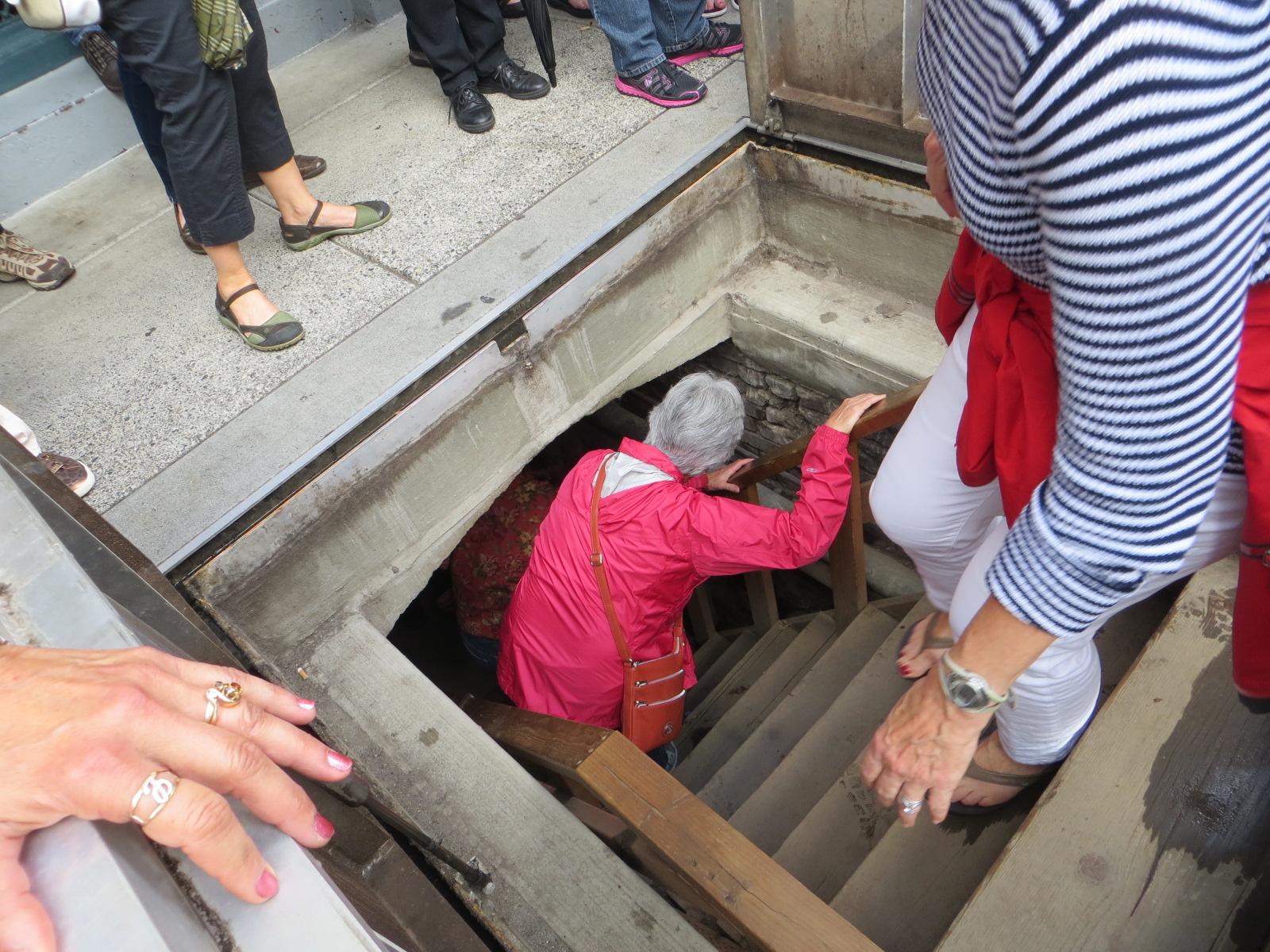
We circled the block, returning to the front of Hobo's and watched as the sidewalk opened via steel panels to reveal a steep stairway to the world below. We crouched to avoid head bangers and entered the dark, musty, warm tunnel, grabbing a flashlight along the way just in case we needed to check a dark corner somewhere. Tiny battery powered mining lights glowed with just enough light to allow us to stumble along together as we explored the excavated remains of a dingy tunnel system designed and built by Chinese slaves and used by greedy, heartless "business men" to entrap, secure and supply crews for outgoing ships as well as women to satisfy the baser needs of men in the area.

Booze and opium were the lures. Dark, airless, barred cells were the stupored memories. Six years of hard, dangerous and sometimes fatal work aboard a seagoing ship were the result of imbibing. Human life was cheap if of any value at all except for what it could bring the shanghai-ers. They were so deceitful that they would even sell dead bodies or a wooden Indian to sea captains looking for a "bargain" in crew supply. 

The horror stories are not edifying to repeat here, but suffice it to say that it was not a proud time in Portland's history. But the greater concern is that this human trafficking still exists today, not in dropping drunks through a trap door in the bar floor, but in enticing young street kids to go with evil-intending scouts to be captured for a quick sale into the world of white slavery. 

VooDoo Donuts, Darcelle's Female Impersonators, Dixie's Tavern and a nearly naked, towel-draped man walking the sidewalk provided the ambiance for the tour and an awareness that life downtown ain't what it is in the 'burbs! 


A dinner hour at Louie's Oyster bar, an historic dining establishment in the area, provided a great place to talk it out, catch up on friends' lives, meet guests and generally enjoy the bounty of the Northwest. MAX carried the majority of tired tourists to their destinations for a brief respite before regathering on Thursday for another great hike in the Mt. Hood National Forest. Twin Lakes is our objective, good times is the fuel for our friendships. Join us when you can because it's not about the destination; it's all about friends connecting in delightful places and being thankful for each other. 

Upper Twin Lake Hike

Spontaneous trunk cracking
Early start, communication snag, regroup and hike! The warm, overcast day began with a gathering of nine hikers eager to hit the trail. We reconnoitered at the Barlow Trailhead and headed for Twin Lakes. The sweet smell of fragrant pine, hemlock and Douglas fir scented the breeze as we walked along the dampened trail. It was a perfect hiking day with a promise of blue skies and warming temperatures. 

The forest had a thinned, diseased look to it due to a bug infestation. According to this report by the Pacific Biodiversity Insititue "The primary insect damage to trees in the Mt. Hood National Forest in recent years has been caused by mountain pine beetle (Dendroctonus ponderosae),firengraver beetle (Scolytus ventralis) and balsam woolly adelgid,(Adelges piceae)  In the past, western spruce budworm(Choristoneura occidentalis) has caused significant damage in some areas. Most of the recent tree mortality has been caused by mountain pine beetle. "
Dead logs across the trail

There were downed logs across the trail but a renewal in the undergrowth is seen in sprouting fir trees amid the dead ones as well as luscious new growth tips on existing live trees . Bear grass was just starting to bloom near the trailhead and a few other small forest flowers dotted the greenery with their bright colors. The six mile hike took us to various decision points as we wound our way toward Upper Twin Lake. This was the one we missed last year due to trail chatting and inattention. This year, with the help of a map, we made all the right turns and arrived at a lovely rippling lake surrounded by a forest of evergreens. The mosquitoes were delighted with fresh "treats" provided by hiker flesh, but a quick application of bug repellent and the donning of shirts and jackets put a stop to the feast. 

Forest toilet. Ewwww. 
Meadow Death Camus
Upper Twin Lake
Upper Twin Lake, another view
We enjoyed a relaxing lunch spot and wondered at the metal forest toilet filled with campfire debris. Ah, those unanswered questions. Returning on the same trail, we made good time back to the cars and proceded to Govy, i.e. Government Camp, for lattes and huckleberry ice cream cones. An Olympic skiing medalist, Ted Ligety, was signing posters at a skiing camp so we got in line for our share of fame nearness. Little grandsons will be delighted with their signed posters soon.  Ted was a true professional with the kids, signing upwards of 200 posters and smiling consistently for all the photo requests. He is a Shred ski rep. The day was full of friendship conversations, encouragement and laughter. Join us in two weeks for another great trek into the Northwest's bounty of trails.

Gillette Lake Hike

Table Mountain
 Gillette Lake July 11, 2013

It was a perfect day for a hike into the nearby Columbia Gorge: clear, blue sky, just enough wind to cool the perspiring hikers, the trail well trodden and the picnic absolutely wonderful! Eleven happy hikers, maps secured in pockets, crossed the Columbia River at Cascade Locks' Bridge of the Gods in anticipation of another invigorating  trek. We quickly marched up the hills for 2.6 miles to reach the picturesque Gillette Lake, a blue-greenish puddle of water at the bottom of a natural bowl under the Bonneville Dam power lines. Table Mountain and Sacajewa with her papoose stood silent guard over the hillside.  Berries are sweetening up these days, wild blackberries and thimbleberries in particular. The mid-summer wild flowers dot the greenery with blues, yellows and purples, always happy to see humans trudging through their territory. The shiny poison oak in its various forms threatened legs along parts of the trail but we stepped lively to avoid contact with the itchy plant. The vine maples timidly situated themselves for dramatic fall color in a few months when the flowers are gone and the temperatures fall. A young eaglet or osprey balanced precariously on a high branch, testing the wind in its wings before launching into the open spaces and warm thermals to soar along the Gorge walls.

Gillette Lake
This was a popular destination today as a group was lunching when we got there and a young man, Jared, was just finishing his breakfast of Red River cereal while another party of elderly women followed us up the trail. MJ's snow-faced Visla Eba made for the lake, chasing sticks and generally enjoying the cool lake water. We spread our shared lunch items on the rocks, passing deviled eggs, mushroom/spinach quesedillas, summer sausage, mushroom-enfused brie, pickles, sweetly ripe cantaloupe, strawberry-filled chocolates, blueberries galore and a little wine. Ah, what a gourmet picnic!

Summer blue sky
Amid the clusters of chatting hikers, we discovered that Jared, an 18 year old from Calgary, Canada, didn't really have exact, or even vague plans for his five day hike/hitchhike journey. After a bit of discreet "mothering" with food tidbits, encouraging comments and general inquiries, we steered him on his way to Highway 14 and points east, primarily Glacier National Park in Montana before reaching home once again. We wished him well but wondered at his limited wisdom in traveling without maps or a plan.

Wild blackberries workin' on sweetness
Although some hikers wore or brought swimsuits, no one ventured into the lake today. What? No risk takers? Alas, we returned from whence we started, helping K. ice a bruised knee and agreeing to meet again next Thursday for another jaunt into the wondrous Northwest terrain.


Lovely Lavenders

The warm days of July, the unofficial start of summer in the Pacific Northwest, bring a lavender haze to small acreages in the area. Bumble and honey bees busily visit as many of the tiny blooms as possible before the delicate flowers fade and drop from sight. Most of the mini-farms of lavender growers sponsor festivals on the weekends to lure city folk to their lush plantings of lavender mounds. 

The visitors, scissors and basket in hand, stroll along the rows of mounded lavenders, clipping bunches to their heart's content. Children chase the bees and squeal when surprised by a worker bee intent on hauling its daily quota of pollen. A band plays and sings folk tunes at the perimeter of the farm amid tented displays of lavender-inspired art, jewelery, foods, soaps and crafts. At this particular farm, all the seating is painted a matching hue of lavender and displays of the fragrant plant are tucked into every possible type of container. 

The season is short but the uses of lavender are many: ribbon-woven wands, scented honey and candy, homemade soaps, wreathes, laminated bookmarks, armloads standing in stately vases, small bundles tied to clothing hangers to name but a few.  Hurry out to a field near you to enjoy this lovely lavender crop and bring a bit of nature back to your abode.